Thursday, March 29, 2012

My Interview with Rev. Samih Mouris

I made this interview with Rev. Samih Mouris in August 2011, specially for Christ at the Checkpoint. I must admit there are few people I respect more than Rev. Samih Mouris. He is the most influential Evangelical leader in the Arab world today, and it was indeed an honor to sit with him for this interview.

Rev. Samih Mouris from Christ at the Checkpoint on Vimeo.

Wednesday, March 28, 2012

Palestinian Christians React to Israeli Ambassador’s Claims about Holy Land Churches

Here is my article in Sojourners in response to the Israeli Ambassador Michael Oren.

Here is an open letter written by a group of Palestinian Christian leaders in response as well.

And this an article from Israel journalist Amira Hass in Haaretz about the same issue.

This is the original letter by ambassador Oren in WSJ.


Saturday, March 24, 2012

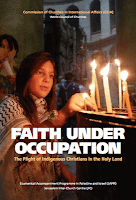
Faith Under Occupation

The Ecumenical Accompaniment Programme in Palestine and Israel (EAPPI) has published a new book called Faith Under Occupation. The Plight of Indigenous Christians in the Holy Land. The book narrates stories of Palestinian Christians and their struggles in face of the Israeli occupation. According to the Introduction of the book,


Many people in the West tend to view the Palestinian-Israeli Conflict as a Muslim-Jewish one, and unless they belong to either of these faiths, they often find it difficult to relate to the conflict and those who are affected by it. This report aims to expose the grim realities of life under Israeli military occupation, and the impacts that it has on all Palestinians, such as land and water confiscation, settlement expansion, access and movement issues, violence, residency rights and many other human rights violations as told by Palestinian Christians.


The book is about real life stories and real life struggles, and gives an insight into issues that are seldom told in the Media, like the water distribution, tourism control, and residency rights. It also tells the story of some of the most "forgotten" Christians, those who live in remote Palestinian villages like Taybeh, Zababdeh and Burqin. 

These stories give voice to Palestinian Christians, and they come in a very important time. Two weeks ago, the Israeli ambassador to USA Michael Oren, claimed in an article in WSJ that the exodus of Palestinian Christians from the West Bank and Gaza is the fault of Palestinian Muslims. The article was full of inaccuracies and even lies, and Palestinian Christians responded with anger and disgust. WSJ was then forced to feature some of these responses

This is a serious issue for Palestinian Christians. We are not saying that radical Isalm is not a threat. We are not denying that there are some struggles that we face as a minority. We are not denying that there are some incidences in which Christians were attacked by radical Muslims, like in the death of Rami Ayyad in Gaza. 

What we are saying, is that for us, the real issue and the core of our struggles is the Israeli occupation. The occupation is real. (Please read the book mentioned above!) It has been our reality for the last 45 years. It is the main reason why Palestinian Christians are leaving. Every Palestinian Christian leader and every major Christian movement, Orthodox, Catholics and Protestants alike, have stressed this. The Kairos Palestine document, which clearly states that the occupation is the core issue for Palestinian Christians, was endorsed by all the heads of the Churches. In addition, when one speaks about the exodus of Palestinian Christians from the Holy Land, it must be stressed that almost fifty to sixty thousand Christians were forced to leave historical Palestine as a result of the Nakba of 1948. 

To insist that radical Islam is the real struggle for Palestinian Christians undermines the struggles and sufferings of Palestinian Christians caused by the occupation, and label these struggles as imagined and unreal. This is insulting. To blame the Muslims is in reality an attempt to mask the injustices of the occupation. It is also an attempt to color the conflict with familiar Western "black and white" colors. This is in fact the shameful goal behind Oren's article: to stereotype Palestinians as radical Muslim persecutors of Christians, whereas Israel is the real and only ally for Christian Americans who are concerned for Christians in the East. 

I suggest that ambassador Oren spends time listening to Palestinian Christians, instead of talking on their behalf. Perhaps he should listen to the almost 50 Palestinian Christian families from Beit Jala near Bethlehem, whose land is under the threat of being confiscated by his own government. Yesterday, I again joined members of these families in their weekly prayer which they have been holding in the land for the last four months. These families have been persistant in their stand against this injustice, holding without any interruption the prayer despite some cold and windy whether. Their persistency and patience is amazing, and the continual presence of many international activists is an encouraging factor. These families decided to put their hope in God and in God alone, for it is Him who is our real and only hope in the Holy Land. 


Thursday, March 15, 2012

The Fight for Recognition and Against Ideology

By Porter Speakman, Jr & Munther Isaac

Earlier this week a report came out via blogs and social media that Dr. Naim Khoury, the pastor of the First Baptist Church in Bethlehem, was told by the Palestinian Authority (PA) “to shut the doors–they were closing down the church” and that the PA no longer recognized the church as legitimate. The report was issued by Russ Resnik, the executive director of the Union of Messianic Jewish Congregations (UMJC). Many pro-Israeli organizations and individuals quickly took it to Twitter, Facebook and personal blogs to try to make a connection between what happened and the Christ at the Checkpoint Conference, which just took place last week in Bethlehem. They also blamed the PA’s actions on the fact that Dr. Khoury is pro-Israel and takes a Christian Zionist stance in his theology, and because of these beliefs his church was being “shut down”. There was only one problem with Mr. Resnik’s report. It was factually wrong.

Upon hearing the news, other local Evangelical leaders among the Palestinian church reached out to Dr. Khoury and his family to hear what had happened. The Khoury family seemed surprised at the report that was being generated by interviews with their son, Steven Khoury, currently in the USA, and denied that the church was “shut down.” Mr. Resnik, to his credit, has now issued a public correction stating “after a further conversation with Pastor Steven Khoury” the statement that the “doors were being shut” by the PA was “not accurate”. What happen is that the PA told Dr. Khoury that his church is not officially recognized by the government or licensed to issue marriage documents, which is by no means new news. This has nothing to do with the church being “pro-Israel.” Nevertheless, it still made it to some pro-Israel websites.

This brings up a bigger issue among Evangelical churches in the Palestinian Territories: official recognition by the PA. Unlike traditional churches like the Greek Orthodox and Catholics, Evangelical churches in the Palestinian Territories are not officially recognized and therefore things like marriage documents are not considered legitimate by government authorities. They have the freedom to worship, but are not “official.” This goes back all the way to the Ottoman Empire days and then the British mandate, and only the thirteen churches that were recognized back then continue to have recognition in Palestine, Jordan and Israel. (See page 27 of the following document http://www.diyar.ps/media/documents/pal_chr_booklet.pdf). This is not limited to the Palestinian Authority; Evangelical churches are also not recognized by the State of Israel.

For the last few years, there have been many discussions between Evangelical church leaders, including those who organized and spoke at the Christ at the Checkpoint, and officials from the PA. The recognition does not depend entirely on the PA, and the input of the already recognized churches is as equally important. In addition, the congregational nature of the Evangelical churches and the absence of a recognized hierarchy complicate things. 


This is why efforts by Christ at the Checkpoint to highlight the Evangelical Palestinian church are so important. Having Palestinian Prime Minister Dr. Salam Fayyad come for the second time in as many conferences to speak and to see first hand what the Bethlehem Bible College and local churches are doing helps, not hinders, the churches efforts for recognition. In addition, the issue of seeking recognition for Evangelical churches in Palestine and in Israel was openly discussed during the conference.

Critics of the Christ at the Checkpoint Conference pointed out the timing as being ironic coming only days after the conference and Dr. Fayyad’s presence there. In reality, the timing of these ongoing attacks is what is ironic.

So while some would want you to believe that this is about a pro-Israel church being persecuted by the PA, the facts point to a greater struggle for recognition for the Evangelical Palestinian church as a whole. So rather than spending time using this situation for ideological purposes, we should encourage and help not only the church in Palestine, but the Palestinian Authority as they continue to seek to build conditions for a free and democratic Palestine. We should also continue to seek and encourage equal freedoms and recognition for Evangelicals and other religious minorities in Israel. Evangelical congregations and non-orthodox Jews long for recognition in some of the same areas.  Unfortunately, Evangelicals are not fairing better in Israel.

Wednesday, March 14, 2012

My talk at Christ at the Checkpoint

Here is the video of my talk at Christ at the Checkpoint. I was overwhelmed, encouraged and really moved by the responses I received from those who attended. I did not expect such a warm response. I give all the glory to God, for it is His Word that continues to inspire me.

I am grateful for all the positive feedbacks, all those who thanked me in person or wrote to me, or shared and wrote about it. I spoke from my heart, pain and personal experience. My talk was a mix of my story, my frustration from some forms of Evangelical theology, and my understanding of the theology of land. Most importantly, my talk was shaped by continuously being challenged by the Sermon on the Mountain, and I hope that this was reflected.


Munther Isaac: A Palestinian Christian Perspective from Christ at the Checkpoint on Vimeo.

Monday, March 12, 2012

Evangelical church meets "at the checkpoint". Maannews Article

Thanks to Charlotte Alfred from Maannews English for this excellent article that I felt captured a lot of what took place in the conference.

Saturday, March 10, 2012

Christ at the Checkpoint 2012 Press Release and Manifesto

At the last day of the conference, I help drafting the final press release of Christ at the Checkpoint and the 12 points manifesto. These points were endorsed of course by the conference local and international committee, and represent our calling for Evangelical Christians around the world:

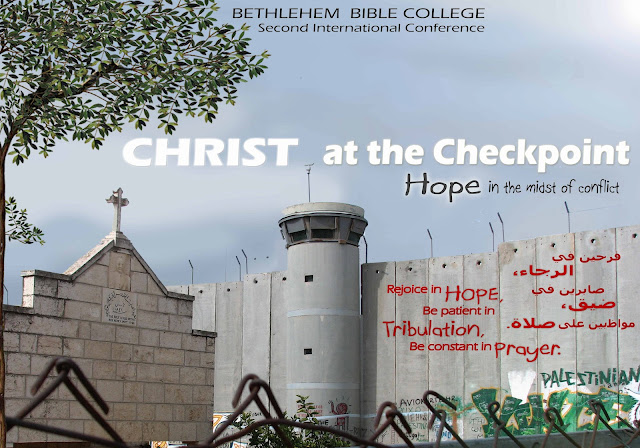
Christ at the Checkpoint: Hope in the Midst of Conflict: 2012

A major breakthrough in the evangelical world took place in Bethlehem through a gathering of over 600 international and local Christians, including renowned evangelical leaders. Organized by Bethlehem Bible College, the conference, under the banner “Christ at the Checkpoint,” addressed the issue of how to find hope in the midst of conflict. The conference exceeded all expectations.

For the first time, a broad spectrum of evangelical believers met literally at the “checkpoint,” and engaged biblically on issues that have historically divided them. Subjects included, Christian Zionism, Islamism, justice, nonviolence, and reconciliation. These themes were intended to create an ongoing forum for Christian peacemaking within the context of the Israeli Palestinian conflict. These issues were discussed in the form of inspirational messages, Bible study, interactive workshops, panels and site visits.

Defying the temptation to despair, Palestinian Christians demonstrated renewed hope to continue to stand against the injustice of occupation nonviolently and forms of Christian Zionism that marginalize them. They also acknowledged the right of the State of Israel to exist within secure borders.

Speakers included John Ortberg, Bishara Awad, Chris Wright, Doug Birdsall, David Kim, Tony Campolo, Lynne Hybels, Munther Isaac, Shane Claiborne, Joel Hunter, Ron Sider, Salim Munayer and Colin Chapman. Participants from 20 nations and a sizeable delegation of university students including Wheaton College and Eastern University, were moved by the testimony of Palestinian men and women who shared the pain and suffering they experience on a daily basis caused primarily by the continuing occupation.

A unique aspect of the conference was the presence and presentations by members of the Messianic community including Richard Harvey, Evan Thomas and Wayne Hilsden, who provided an integral contribution to the dialogue.

Conference organizers challenged the evangelical community to cease looking at the Middle East through the lens of “end times” prophecy and instead rallied them to join in following Jesus in the prophetic pursuance of justice, peace and reconciliation.

The Christ at the Checkpoint Manifesto
  1. The Kingdom of God has come. Evangelicals must reclaim the prophetic role in bringing peace, justice and reconciliation in Palestine and Israel.
  2. Reconciliation recognizes God’s image in one another.
  3. Racial ethnicity alone does not guarantee the benefits of the Abrahamic Covenant.
  4. The Church in the land of the Holy One, has born witness to Christ since the days of Pentecost. It must be empowered to continue to be light and salt in the region, if there is to be hope in the midst of conflict.
  5. Any exclusive claim to land of the Bible in the name of God is not in line with the teaching of Scripture.
  6. All forms of violence must be refuted unequivocally.  
  7. Palestinian Christians must not lose the capacity to self-criticism if they wish to remain prophetic.
  8. There are real injustices taking place in the Palestinian territories and the suffering of the Palestinian people can no longer be ignored. Any solution must respect the equity and rights of Israel and Palestinian communities.
  9. For Palestinian Christians, the occupation is the core issue of the conflict.
  10. Any challenge of the injustices taking place in the Holy Land must be done in Christian love. Criticism of Israel and the occupation cannot be confused with anti-Semitism and the delegitimization of the State of Israel.
  11. Respectful dialogue between Palestinian and Messianic believers must continue. Though we may disagree on secondary matters of theology, the Gospel of Jesus and his ethical teaching take precedence.
  12. Christians must understand the global context for the rise of extremist Islam. We challenge stereotyping of all faith forms that betray God’s commandment to love our neighbors and enemies.

The Statement and Manifesto were presented to the Conference participants on the last day but were only agreed and endorsed by the Conference Organizers.


Conference Organizers:
John Angle, Alex Awad, Bishara Awad, Sami Awad, Steve Haas, Munther Isaac, Yohanna Katanacho, Manfred Kohl, Salim Munayer, Jack Sara, Stephen Sizer


Daoud Kuttab Summary of Christ at the Checkpoint

Here is Daoud Kuttab summary of Christ at the Checkpoint. I found it very insightful. Daoud is a Palestinian Evangelical Journalist who now lives in Jordan. I will write more about the conference in the coming few days, as I am still recovering emotionally and physically from a life-changing and challenging week.


MSNBC Article On Evangelical support to Israel

I was recently interviewed as a part of an article for MSNBC. The full article, which talks about Evangelical support to Israel, is here.